
General
How to Share Pet Care Responsibilities With Your Family (Without Missed Meals or Double Doses)
By Isha Guard · 11 min read
Published
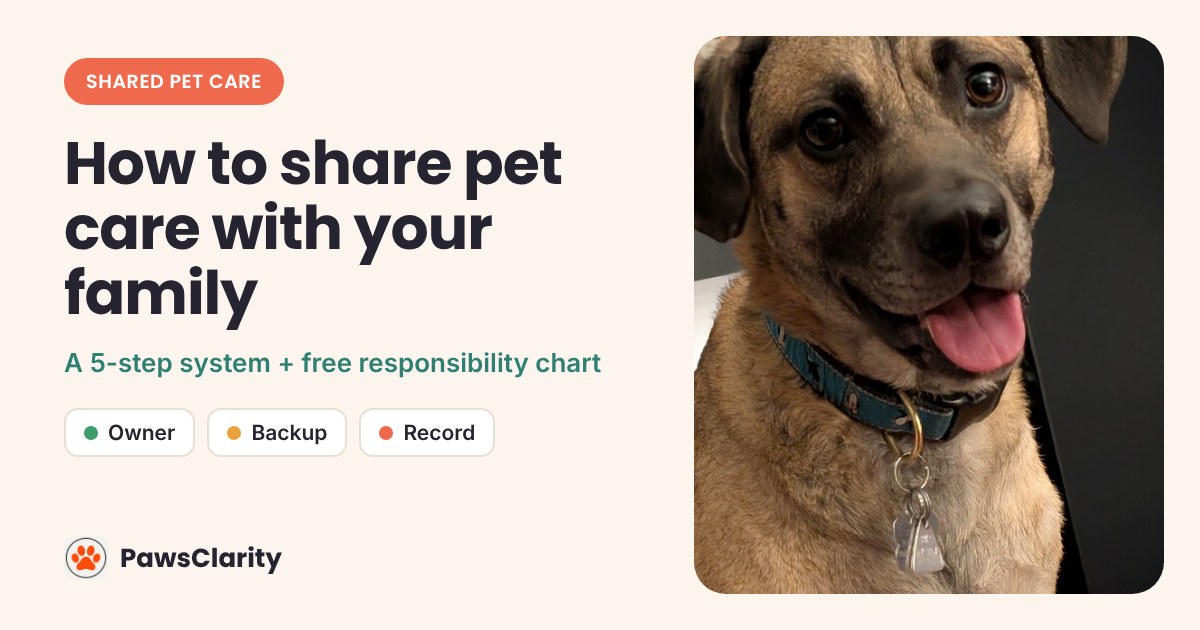
It's 7:40 p.m. Your partner asks whether the dog has eaten. You assumed your teenager fed her after school. Your teenager assumed you did it when you got home. The dog is sitting by her bowl looking hopeful. Nobody actually knows the answer.
Most families who share a pet have had a moment like this. Usually nobody is being careless. The problem is that pet care runs on memory and assumption, and those break down once more than one person is involved.
Sharing pet care well comes down to three things. Every task has one owner. Every task has a backup. Every completed task gets recorded somewhere everyone can see. A chore chart helps with the first one. It doesn't help with the other two, and that's usually where things go wrong.
This guide walks through a five-step system you can set up in an evening, with a responsibility chart you can copy.
The short answer
1. List every task, including the planning work that usually falls on one person.
2. Sort tasks by risk. Medication and prescription diets need stricter rules than playtime.
3. Give each task an owner and a backup.
4. Agree on how "done" gets recorded, and check the record before you act.
5. Hold a short setup talk, then a weekly five-minute check-in.
The rest of this article explains each step.
Step 1: List every task (including the invisible ones)
Start by writing down everything your pet needs. Do it together, because each person will remember things the others forget.
Group tasks by how often they happen:
Daily: meals, fresh water, walks or potty breaks, litter box, playtime, any prescribed medication
Weekly: brushing, washing bowls and bedding, cleaning the yard or cage, restocking treats
Monthly: nail trims, parasite preventives (if your veterinarian recommends them), checking food and medication supplies 1 / 8
Occasionally: vet appointments, vaccinations, license renewals, grooming appointments, arranging a sitter for trips
Then add the tasks families usually miss: the invisible work. These are the planning, remembering, and noticing jobs that keep everything running. They're often done quietly by one person, which is a common source of resentment.
Reordering food, litter, and medication before you run out
Booking and attending vet appointments
Keeping track of when preventives are due
Cleaning up accidents and vomit
Noticing changes in appetite, energy, thirst, or stool, and deciding whether to call the vet
Briefing a sitter or a grandparent who is helping out
If one person currently does all of this, write their name next to it. You'll be redistributing it in Step 3.
Step 2: Sort tasks by risk (Green, Amber, Red)
Not every task carries the same consequences. Brushing the cat twice in one day is harmless.
Giving a prescribed medication twice is not. If you treat every task the same way, you'll either overmanage the easy ones or under-manage the important ones.
Sort each task into one of three tiers:
Tier | What it means | Examples | How to handle it |
|---|---|---|---|
Green | Little harm if done late, skipped once, or done twice | Playtime, brushing a calm pet, refilling water, putting toys away | Anyone can do it, including children with appropriate supervision |
Amber | Causes problems if missed or doubled | Meals, walks, litter box, treats | One owner and one backup. Record it when it's done |
Red | Health-critical | Prescribed medications, insulin, prescription or special diets, post-surgery care | An adult owner only. Follow your veterinarian's instructions exactly. Record it immediately |
Red tasks deserve extra structure, and a few basic medication safety habits make the system safer.The Institute for Safe Medication Practices (ISMP) recommends several medication safety habits for pet owners, including
Storing pet medicines separately from human medicines to prevent mix-ups
Not giving one animal's medicine to another animal unless your veterinarian tells you to
Keeping a complete list of everything your pet takes, including supplements and over-thecounter products
Asking your vet, before you leave the clinic, what to do if a dose is forgotten.
That last point matters more in shared households than anywhere else. Get the answer from your vet while you're there, write it down, and keep it with the medication so every caregiver can see it.
Step 3: Assign an owner and a backup for every task
Now put names next to tasks.
The owner is accountable for making sure the task gets done. That doesn't mean they do it every single time. It means that if it doesn't happen, it's their job to notice and fix it.
The backup steps in when the owner is late, sick, traveling, or stuck at work. Agreeing on this in advance avoids the "I didn't know I was supposed to" conversation.
A few principles make the split fairer and more realistic:
Assign by schedule, not by equal numbers. The person who's home at 7 a.m. should own
breakfast. A fair split is about workload and timing, not an identical task count.
Redistribute the invisible work. Reordering supplies and booking vet visits take real time and attention. Count them.
Consider naming a "pet care lead." One person keeps an eye on the big picture: upcoming appointments, supplies running low, changes in the pet's health. If this role tends to fall on the same person, rotate it monthly.
Example: a responsibility chart for one household
The household below is hypothetical: two adults, a 14-year-old, a 9-year-old, and a senior dog on a
daily prescribed medication.
Task | Tier | When | Owner | Backup | How "done" is recorded |
|---|---|---|---|---|---|
Breakfast | Amber | 7:00 a.m. | Adult A | Teen | Logged when served |
Morning medication | Red | With breakfast | Adult A | Adult B | Logged immediately after giving |
Morning walk | Amber | 7:15 a.m. | Teen | Adult A | Logged after the walk |
Fresh water | Green | Morning and evening | 9-year-old | Teen | Not logged |
Dinner | Amber | 6:00 p.m. | Adult B | Teen | Logged when served |
Evening walk | Amber | 7:00 p.m. | Teen | Adult B | Logged after the walk |
Brushing | Green | Sundays | 9-year-old (with an adult) | Adult B | Not logged |
Reorder food and medication | Amber | When about a week's supply is left | Adult B | Adult A | Noted when ordered |
Vet appointments | Red | As scheduled | Adult A | Adult B | Notes shared after each visit |
Notice that medication sits with an adult owner and an adult backup. Children help with Green tasks and own a few Amber tasks, with an adult as their backup.
Where kids fit: helping vs. owning
Pet care can be good for children, but there's a difference between a child helping with a task and a child being responsible for it. Veterinarian Jennifer Coates, DVM, made this point in PetMD:
expecting young children to handle something important, like daily feeding, without oversight is
asking for trouble.
Rather than relying on a fixed age chart, look for readiness signals before handing a child
ownership of an Amber task:
They can follow written steps on their own (for example, the correct amount of food for each meal).
They've remembered the task without reminders for a couple of weeks while you checked quietly.
They're calm and gentle with the pet, and the pet is relaxed around them.
For walks, they can control the dog on a leash, including when the dog gets excited or pulls.
Even then, an adult remains the backup and checks the record. Red tasks should stay with adults.
A few safety basics from the CDC's guidance on young children and pets apply whatever the child's age:
Always supervise young children around animals.
Keep children away from pets while the pets are eating.
Make sure children wash their hands with soap and water right after touching, feeding, or caring for animals. Adults should supervise handwashing for young children.
The CDC notes that children under 5 are more likely to get sick from germs animals can carry, so they need the closest supervision.
Partners and adults on different schedules
When adults work different hours, divide by time slot rather than by task type. The early riser owns
mornings and the later person owns evenings. This tends to work better than splitting "feeding"
from "walking," because responsibility follows whoever is actually home.
Be careful with "whoever gets to it first." It sounds flexible, and it's fine for Green tasks. For meals and medication it's how double feeding happens, unless completion is recorded the moment the task is done.
Step 4: Agree on how "done" gets recorded
This is the step most families skip, and it's the one that prevents most missed and doubled care.
The rule is simple: if it isn't recorded, it isn't done. And check the record before you act, not after.
Memory fails in predictable ways. You remember meaning to feed the cat, or you remember
yesterday's feeding instead of today's. You see an empty bowl and assume nobody fed her, when
she simply ate quickly. A shared record replaces "I think so" with "it says so."
There are three common ways to keep that record:
Method | Works well when | Watch out for |
|---|---|---|
Paper chart on the fridge | Everyone is usually home, and the routine is simple | You can't check it from work or on a walk. Ticks get forgotten |
Family group chat | Everyone already uses it, and updates are occasional | Pet updates get buried under other messages. It's hard to see at a glance what's done today |
Shared pet care app | Caregivers are often away from home, or the pet is on medication | Everyone needs to install it and actually use it |
Whatever you choose, everyone has to use the same method. A paper chart that half the household ignores is worse than no chart, because it creates false confidence.
If you'd like a dedicated tool, PawsClarity, a shared pet care app for families and caregivers, was built for this. Everyone you invite sees the same live timeline of meals, walks, and doses. Before someone logs a meal or medication, the app checks whether someone else already logged it. If a scheduled dose is late, the owner and whoever is on duty get notified. No tool can stop every mistake. A log is only as reliable as the people using it. But a shared record that everyone checks makes "did anyone feed her?" much easier to answer.
If you're not sure whether a medication was given
Sooner or later someone will be unsure whether a dose was given. When that happens:
1. Don't give another dose "just to be safe." For some medications, a double dose can be more
dangerous than a missed one.
2. Check your shared record, and ask everyone in the household.
3. Follow the missed-dose instructions your veterinarian gave you. If you don't have them, or
you still can't confirm, contact your veterinarian before doing anything else. If your pet seems unwell, call your vet or an emergency veterinary clinic right away.
Step 5: Hold a 15-minute setup talk, then a weekly check-in
A system only works if everyone agrees to it. Sit down together, kids included, and keep it short.
15-minute setup agenda
1. Read through the task list from Step 1 and add anything missing.
2. Agree on the tier for each task.
3. Assign owners and backups. Let people volunteer before you assign.
4. Choose one recording method that everyone will use.
5. Agree on house rules: who can give treats and how many, whether table scraps are allowed,
where the pet sleeps.
6. Put the first weekly check-in on the calendar.
Five-minute weekly check-in
Was anything missed or done twice this week? Why?
Does anyone's load feel too heavy?
What's changing next week: travel, a late shift, a vet visit, a new medication?
Do any owners or backups need to change?
The check-in is where the system stays alive. Without it, most families drift back to "whoever
notices" within a few weeks.
When the system breaks: 5 common problems and how to fix them
Problem | Why it happens | Fix |
|---|---|---|
"I thought you did it" (a missed or double meal) | Completion lives in people's heads | Apply the "check before you act" rule. Make meals Amber tasks with a named owner |
The extra treats nobody counted | Grandparents, guests, or children giving treats without telling anyone | Agree on a daily treat allowance and who can give treats. Log treats if your pet is on a diet |
One person quietly does everything | Invisible work isn't on the chart, or others wait to be asked | List the invisible work in Step 1, and use the weekly check-in to rebalance |
Schedules change and coverage disappears | Travel, illness, or a new job, with no agreed backup | Name a backup for every Amber and Red task, and review upcoming changes weekly |
A new medication or diet starts mid-week | Whoever was at the vet knows the instructions, and nobody else does | Add it to the chart as a Red task the same day, with an owner, a backup, and the vet's written instructions where everyone can see them |
That last problem is worth a closer look, because it's the one most likely to affect your pet's health.
Hypothetical example: On Tuesday, one parent takes the family cat to the vet and comes home with a two-week course of medication, to be given twice a day. They give the evening dose and mention it in passing at dinner. On Wednesday morning that parent leaves early. The other parent, who halfheard the dinner conversation, isn't sure whether the morning dose is theirs or whether it already happened. The teenager saw a pill bottle on the counter and wonders whether it was given.
Nobody in this household is careless. The information simply never made it out of one person's head. With the system in place, Tuesday evening looks different. The medication goes on the chart as a Red task, Adult A owns the morning dose and Adult B is the backup, the vet's instructions (including what to do about a missed dose) sit next to the bottle, and every dose is recorded the moment it's given. On Wednesday morning, anyone can check the record and know exactly where things stand.
Printable: your family pet care responsibility chart
Copy this table into a document, print it for the fridge, or recreate it in whatever tool your family
uses.
Task | Tier (Green / Amber / Red) | When | Owner | Backup | How "done" is recorded |
|---|---|---|---|---|---|
Fill it in during your setup talk. Then revisit it whenever something changes: a new pet, a new
medication, a new school or work schedule.
The takeaway
Sharing pet care works when nobody has to guess. Give every task one owner and one backup, treat health-critical tasks with extra care, and make "done" something everyone can see rather than something someone remembers.
Tonight, take 15 minutes to list your tasks and fill in the chart. Run your first weekly check-in a week later. If your household needs a shared record that works when people aren't home, you can try PawsClarity free during the beta.
This article is general information about organizing pet care at home. It isn't veterinary advice. Always follow the instructions your veterinarian gives you for your pet's medications, diet, and health.