General
The Complete Guide to Managing Pet Care Across Multiple Caregivers
By Isha Guard · 16 min read
Published
On Tuesday, the vet moves your dog's evening pill from 6 p.m. to 8 p.m. You tell your partner that night. But the midday walker still has the note you sent in March, the weekend sitter has a printout from your last trip, and your mother, who takes the dog when you travel, has her own version saved in a text thread.
Nobody did anything wrong. There are just four copies of the instructions, and only one of them is current.
That's the real challenge of having several caregivers. More helpers isn't the problem. More versions of the truth is. The fix is simple to describe: map everyone who cares for your pet, keep one care profile they all work from, record care in one place, and hand off care the same way every time.
This guide walks through each step, with a template, a 60-second handoff script, an emergency plan, and a checklist for giving people access (and taking it back).
The short answer: five rules for a care circle
Map who's involved. Group everyone who cares for your pet by how often they're there and what they need to know.
Keep one care profile. One dated set of instructions, one person who updates it, and everyone works from it.
Record care in one place. Outside caregivers write to the same record as the household, not to a separate text thread.
Hand off the same way every time. Done, Due, Watch, Ask.
Give access deliberately, and take it back. Keys, codes, and app links have a start date and an end date.
If most of your pet's care happens inside your household, start with our guide to sharing pet care responsibilities with your family, which covers splitting tasks between partners, kids, and housemates. This guide picks up where that one stops: the walkers, sitters, relatives, neighbors, daycare staff, and second households who make up the rest of your pet's care circle.
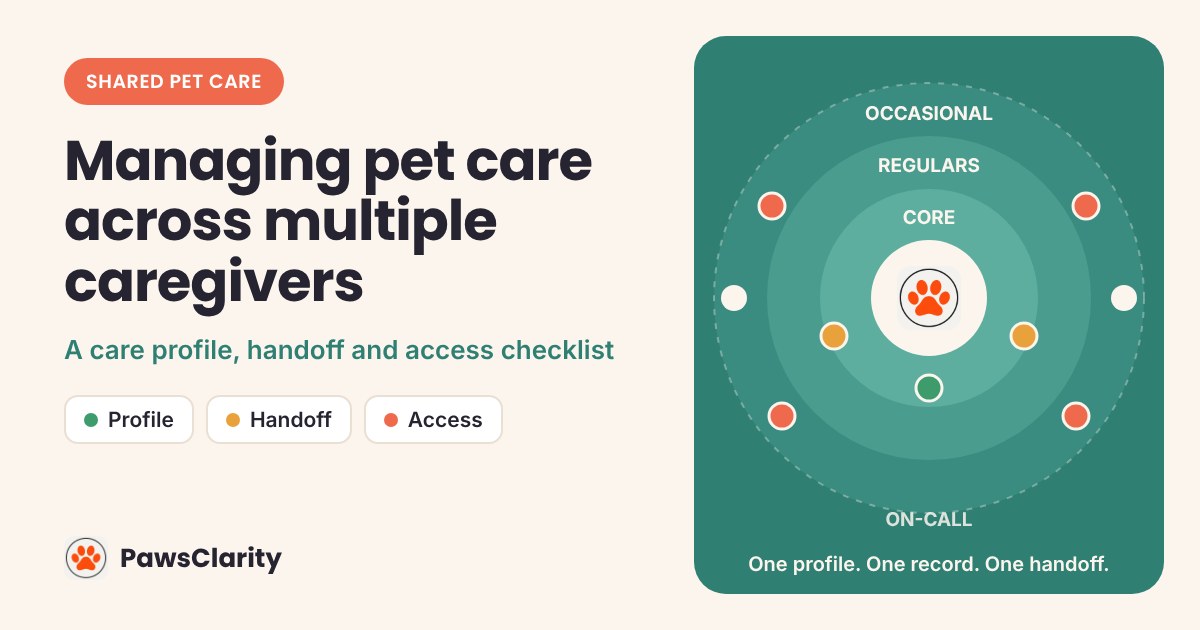
Map your pet's care circle
Different caregivers need different information. A one-time walker doesn't need your alarm code. An overnight sitter needs your pet's full medication list. When everyone gets the same thing, you either share too much or too little.
Sort your caregivers into four rings:
Ring | Who | Needs to know | Access | Records care by | Access ends when |
|---|---|---|---|---|---|
Core | You and anyone in your household who makes decisions about the pet | Everything | Full | The shared record | Never (but review yearly) |
Regulars | Dog walker, daycare, a co-parent's household, a relative who helps every week | Routine, rules, health info, who to call | What their visits require | The shared record, every visit | The arrangement ends |
Occasional | Pet sitter, boarding facility, a neighbor who checks in | Routine, rules, full health info for the stay, emergency plan | Only for the dates booked | The shared record, every visit | The stay ends |
On-call | Backup decision-maker, your vet clinic, the nearest emergency clinic | Who's caring for the pet and when; what they're authorized to decide | None by default | Not applicable | Not applicable |
Two roles inside the Core ring make everything else work:
The profile keeper. One person owns the care profile and is the only one who edits it. Everyone else suggests changes to them. This is what stops four versions from appearing.
The backup decision-maker. Someone who can make a call about your pet if you can't be reached. The American Kennel Club suggests naming a trusted person for this role, and getting their agreement first. Don't assume your sister will say yes at 2 a.m. Ask her now.
Build one care profile everyone works from
A care profile replaces the note on the counter, the screenshot in the group chat, and the "oh, and one more thing" at the door. It's one document, with a date at the top, organized in three layers so you can share each layer only with the people who need it.
Layer 1: For everyone
Every caregiver, from a one-off walker to your mother-in-law, gets this layer.
Daily routine with times: meals, walks, potty breaks, bedtime.
Portions: the exact amount, and what to feed it from (the scoop, the container).
Treat rules: which treats, how many, and who's allowed to give them.
House rules and cues: furniture, greetings, the words you use for "sit," "come," and "leave it." (More on this below.)
Behavior notes: fears, triggers, habits, hiding spots, anything that looks alarming but is normal for this pet.
Hazards: things the pet must not get into, escape routes, other animals nearby.
Contacts: you, your backup decision-maker, and the order to try them in.
Layer 2: Health
Share this layer with anyone who will give food or medication, or who will be alone with the pet overnight.
Medication list. The name, dose, and timing of each medication, written exactly as it appears on your veterinarian's instructions. The Institute for Safe Medication Practices recommends keeping a list of every medicine your pet takes, including over-the-counter products and supplements, and keeping each one in its original labeled container.
Where medications are kept, and a note that they're stored away from human medicines (ISMP recommends this to prevent mix-ups).
Diet notes: a prescription diet, allergies, foods that have caused problems before.
Vet details: your regular clinic, the nearest 24-hour emergency clinic, and the ASPCA Animal Poison Control Center at (888) 426-4435. It's available 24/7; a consultation fee may apply.
Emergency authorization: whether you've signed a veterinary release form, and any spending limit (see the emergency section below).
When a new caregiver will be giving medication, go through this layer with them in person. The ASPCA recommends reviewing medications with your sitter face to face rather than relying on a written note alone.
Layer 3: Home access
Share this layer only with the people who need to get in.
Keys and who holds them
Door, gate, and alarm codes
Where the leash, carrier, cleaning supplies, and first aid kit are
Anything about the house the caregiver needs to know (a sticky lock, a gate that doesn't latch, a breaker box)
Keep it current
A care profile that was right in March is a hazard in October. Four habits keep it accurate:
Date every version and put a one-line "What changed" note at the top: "Oct 27: evening pill now 8 p.m., not 6 p.m."
Only the profile keeper edits. Everyone else sends changes to them.
When Layer 2 changes, tell every ring the same day. A medication change that reaches your partner but not your walker is one of the easiest ways for a care circle to break.
Ask caregivers to delete old copies. Or keep the profile somewhere shared, so there's only ever one copy.
Template: the care profile at a glance
Section | What to include | Share with |
|---|---|---|
Header | Pet's name, photo, date of this version, "What changed" | Everyone |
Layer 1: Routine and rules | Times, portions, treats, cues, behavior, hazards, contacts | Everyone |
Layer 2: Health | Medications as written by your vet, storage, diet, vet and emergency clinic, poison control, release form | Anyone feeding, medicating, or staying overnight |
Layer 3: Home access | Keys, codes, where supplies are, house quirks | Only people who need to get in |
Agree on one way to record care
Instructions say what should happen. A record shows what did happen. You need both, because they answer different questions. The profile answers "What time is dinner?" The record answers "Has she had dinner?"
Without a shared record, each caregiver keeps their own: the walker texts you, the sitter sends photos, your partner remembers. Nobody can see the whole day. As one veterinarian-reviewed guide puts it, an empty food bowl isn't enough to confirm your pet is okay. Someone has to look at the pet and write down what they saw.
Agree on three things:
Where it's recorded. One place, used by everyone, including caregivers outside the household. A separate thread for the walker is how the walker's information gets lost.
What gets recorded. At minimum: meals, medications, walks, and anything unusual. Regulars and sitters record every visit.-
The rule from our family guide: check the record before you act, not after. It's the single habit that prevents duplicate meals and missed tasks.
A paper log works when everyone is in the same house. Once walkers, sitters, or a second household are involved, you need something everyone can see from wherever they are.
That's the problem PawsClarity was built for. Walkers and sitters can log meals, walks, potty breaks, and medications from a private guest link, without creating an account or paying; the household's plan covers it. Each entry appears on the shared timeline under the caregiver's name, so you can see who did what and when. Entries can't be deleted, only marked "entered in error," so the record
stays honest. It's still a record, not a safeguard: it only knows about care that someone actually logged.
Hand off care the same way every time: Done, Due, Watch, Ask
Most gaps in a care circle open at the moment care changes hands: the walker leaving, the sitter arriving, the dog going to the other household for the weekend. Hospitals know this well; it's why many use structured handoff scripts. In one large study across nine pediatric residency programs, introducing a standardized handoff program was associated with a 23% relative reduction in preventable adverse events. That's human medicine, not pet care, but the lesson carries over: when handoffs follow the same structure every time, less gets lost.
Here's a four-part handoff for pet care. It takes about a minute out loud, or two lines in writing.
Step | What to say | Example |
|---|---|---|
Done | What happened since the last handoff | "Walked 30 minutes at 12:15. Peed and pooped, normal." |
Due | What's next, and when | "Dinner at 6. Evening pill at 8, with food." |
Watch | Anything unusual or worth keeping an eye on | "Limping slightly on the back left after the walk." |
Ask | Anything uncertain, and who to contact | "Not sure if the gate latch is broken. Call Dana if the limp gets worse." |
If there's nothing to watch, say so: "Nothing unusual." That's information too.
Walker to owner (every visit)
A two-line written update, sent from the walk or added to the shared record. Done and Watch are the essentials. Agree on this format when the walker starts, so you're not getting "All good!" one day and a paragraph the next.
Owner to sitter, and sitter to owner (start and end of a stay)
At the start, walk through the care profile in person or on a call, and finish with Due: what's coming in the first 24 hours. At the end, ask the sitter for a full Done–Due–Watch–Ask before they leave.
One practical tip from Vetstreet: ask your sitter to keep your house key until you're actually home. If your flight is delayed, your pet isn't left with no one able to get in.
Between two households
When a pet moves between homes (co-parents after a separation, a grandparent who takes the dog every other weekend), the handoff has two parts:
The pet's things travel with a checklist: food, medications in their original containers, leash, bed, anything the other home doesn't keep.
Both homes work from the same care profile and the same record. Two households with two different medication schedules is a recipe for a missed or doubled dose.
Use Done–Due–Watch–Ask at the door, even if the conversation is otherwise brief.
Medication when more than one person is involved
Medication is where a care circle carries the most risk, because a dose that's missed or given twice can matter. Our family guide treats prescribed medications as health-critical tasks with stricter rules. With caregivers outside the household, add these:
One named person per dose. For each scheduled dose, decide who gives it. "Whoever's around" is how two people both give it, or neither does.
Record it immediately. Not at the end of the visit. Right after the dose.
Same-day updates. When your vet changes a medication, dose, or timing, update the care profile and tell every caregiver who gives medication that day.
Original containers, one per pet. Keep each pet's medicine in its labeled container. ISMP advises never giving one animal's medicine to another unless your veterinarian directs it.
Ask your vet one question in advance. ISMP suggests asking, before you leave the clinic, what to do if a dose is forgotten. Write the answer into Layer 2 so no caregiver has to guess.
Not sure whether a dose was given?
Don't give another dose just in case. Check the shared record, then ask the last person who cared for your pet. If you still can't confirm, contact your veterinarian and follow their instructions.
Plan for emergencies before anyone needs to
An emergency is the worst time for a caregiver to work out who to call. Give every Regular and Occasional caregiver an escalation ladder: the order to follow when something goes wrong.
The escalation ladder
If the pet is in immediate danger (trouble breathing, collapse, severe bleeding, suspected poisoning with symptoms), go to the nearest emergency veterinary clinic now and call the owner on the way.
For anything urgent but not immediately life-threatening, call the owner.
If the owner can't be reached, call the backup decision-maker.
If neither can be reached, call the pet's regular vet clinic (or the emergency clinic after hours) and follow their advice.
For suspected poisoning, call your vet or the ASPCA Animal Poison Control Center at (888) 426-4435
Put the ladder at the top of Layer 2, with names and numbers filled in.
Authorize care in advance
Many professional pet sitters ask clients to sign a veterinary release form: written permission for the sitter to get emergency care for your pet if you can't be reached. According to Pet Sitters International, these forms often include a pre-approved spending limit, and some clinics require the owner's own consent before treating a pet in a sitter's care.
Because clinic policies vary, do two things before you travel:
Call your vet clinic. Tell them who will be caring for your pet and when, and ask what they need from you to treat your pet if you can't be reached. The ASPCA also recommends telling your vet who can authorize decisions while you're away.
Agree on a spending limit with your backup decision-maker, so they know what they can approve without you.
This is general information, not legal advice. Requirements can differ by clinic and location.
Give access deliberately, and take it back
Every care circle changes over time. Walkers move on, a neighbor stops helping, a sitter books with someone else. Access that was given and never removed is a quiet risk: a key in a drawer you've forgotten about, a door code three former walkers still know.
Treat access as a lifecycle with a clear start and end.
Onboard
☐ Meet-and-greet or a trial visit while you're home
☐ Walk through Layers 1 and 2 of the care profile
☐ Test the key or code together
☐ Agree on how they'll record care and send handoffs
☐ Add them to your escalation ladder, if they'll be caring for your pet alone
Active
☐ Share only the layers and pets they need
☐ Send profile updates the same day they change
☐ Confirm the booking dates in writing
Offboard
☐ Collect keys, or confirm where they are
☐ Change door and gate codes if they had them
☐ Remove app access and group chats
☐ Run the five-minute debrief (below)
☐ Thank them, and note whether you'd book them again
If you use PawsClarity, guest links for walkers and sitters are limited to the pets they were booked for and the booking dates. The link stops working automatically when the booking ends, and you can revoke it at any time.
Keep rules and cues the same in every pair of hands
A dog that sits for you but not for the walker usually isn't being stubborn. The American Kennel Club notes that everyone the dog lives with needs to use the same cues and rules. If one person says "come" and another says "here," or one person allows begging at the table and another doesn't, the dog can't learn what's expected.
The same logic applies to caregivers who aren't in the house every day. Add a short list to Layer 1:
The cues you use, word for word: "sit," "wait," "leave it," "off," "come."
Treat policy: which treats, how many, and whether they're used for training.
Furniture and bed rules.
Greeting rules: does the dog have to sit before being petted?
Leash and handling: harness or collar, which side, how to handle pulling.
For reactive or anxious pets: triggers, warning signs, and what to do. Put these at the top, not buried at the end.
When the care circle breaks: common problems and fixes
Problem | Why it happens | Fix |
|---|---|---|
The walker is working from old instructions | A change reached the household but not the outer rings | One profile keeper; Layer 2 changes go to every ring the same day |
Everyone thought someone else was covering | Travel days and schedule changes blur who's on duty | Write each day's caregiver into the plan for that week, including the backup |
A sitter didn't know who to call | Contacts were spread across texts and a fridge note | The escalation ladder at the top of Layer 2 |
A former walker still has a key | Nobody offboarded them | The offboard checklist, every time |
The dog arrived at the other home without meds | The two households hand off belongings, not information | A checklist that travels with the pet, plus Done–Due–Watch–Ask at the door |
The main caregiver is worn out | Senior or complex-care pets need a lot of daily attention, and it often falls to one person | Share the load deliberately, and talk to your vet team (see below) |
That last one deserves a note. The American Animal Hospital Association's senior care guidelines acknowledge that caring for an older pet can take an emotional and physical toll on caregivers, and suggest that veterinary practices help clients find pet-sitter and respite contacts. If you're carrying most of the load, say so at your next vet visit. Bringing in a walker or sitter is part of caring well, not a failure to cope.
A hypothetical week, replayed two ways
This is an illustrative example, not a real household.
Without a care circle. Dana's 13-year-old dog, Pepper, takes a pill twice a day. Dana is traveling for five days. Sam, the regular walker, comes at noon. Rhea, a sitter, stays overnight. A neighbor, Luis, is the backup. On Monday, the vet moves Pepper's evening pill to 8 p.m. with food. Dana texts Rhea, but forgets Sam. On Wednesday, Pepper seems stiff after her walk; Sam mentions it to Rhea at the door, but Rhea is on a call and it doesn't register. On Friday, Dana's flight is delayed, and Rhea has already left her key on the counter, as Dana's original note said. Luis has the spare key and steps in for the evening, but he's working from the old note, so he doesn't know the evening pill is now at 8 p.m. with food.
With a care circle. The vet change goes into the care profile on Monday with a "What changed" line, and Dana sends it to Sam, Rhea, and Luis at once. Sam's Wednesday handoff goes into the shared record: "Done: 30-minute walk. Watch: stiff on her back legs afterward." Rhea sees it that evening and mentions it to Dana, who decides to call the vet. Rhea keeps the key until Dana confirms she's home, and Luis, as backup, already has the current profile.
Nothing about the second version required more people or more work. It required one profile, one record, and the same handoff every time.
After every stay: a five-minute debrief
When a sitter finishes a stay, or a walker's arrangement changes, ask five questions while it's fresh:
What went well?
What was missed, unclear, or hard to find?
What did you notice about the pet?
What should we change in the care profile?
Would we book this again, and would we change anything?
Then update the profile. Over a few stays, your instructions get sharper, and every new caregiver starts from a better version.
Your care-circle kit
Everything in this guide fits on three pages:
The care profile: the three-layer template, with the escalation ladder at the top of Layer 2
The handoff card: Done, Due, Watch, Ask, with an example
The access checklist: onboard, active, offboard, and the five debrief questions
Copy the template and checklists above into a document, or print them for the fridge and the sitter's welcome folder.
The takeaway
You don't need fewer caregivers. You need one version of the truth: one care profile, one shared record, and one way of handing off care that everyone uses.
Start tonight with Layer 1 of your care profile, and send it to your regular walker or sitter. When the record needs to work for people outside your home, you can download the PawsClarity app. Walkers and sitters log for free through guest links. The free plan covers one pet and one caregiver; Plus ($5.99 a month per household) adds unlimited pets and caregivers.
This article is general information about organizing pet care. It isn't veterinary or legal advice. Always follow your veterinarian's instructions for your pet's diet, medications, and health, and contact a veterinarian right away if your pet shows signs of illness.