General
Who Fed the Dog? How to Prevent Duplicate Feeding in Busy Households
By Isha Guard · 10 min read
Published
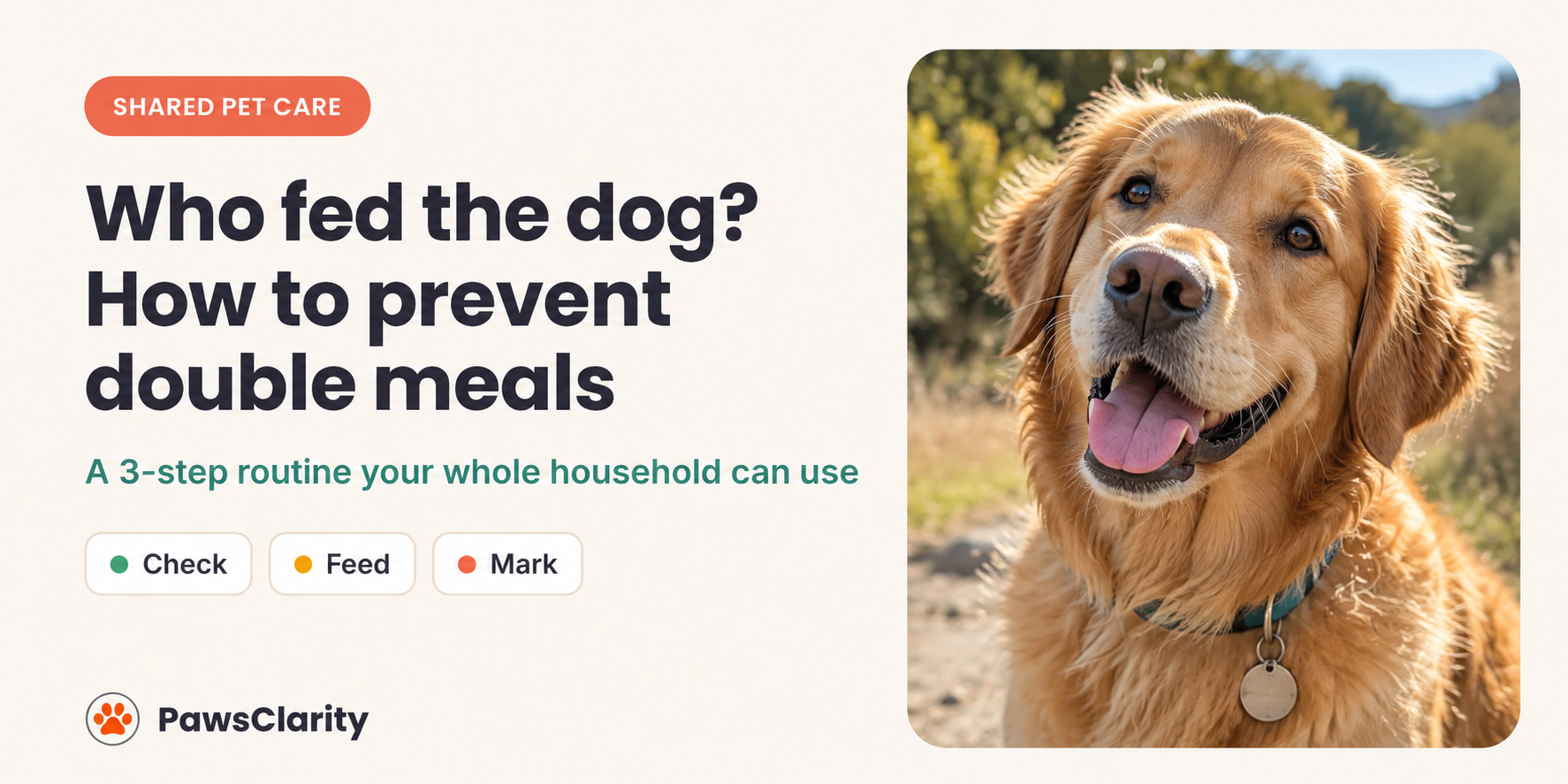
It's Saturday, a little after eight. The dog is sitting next to her bowl, staring at you. Your partner is in the shower. You have a vague memory of someone rattling the food scoop earlier, but it might have been yesterday. The dog certainly isn't telling.
Double feeding rarely happens because someone is careless. It happens because "fed" lives in one person's head, and the bowl looks the same five minutes after breakfast as it does before it. The fix is to make feeding visible: check, feed, mark.
This guide covers what to do if you're unsure right now, the six moments double meals usually happen, and the methods that keep working even when someone forgets.
Not sure if your dog already ate? Start here
Work through these in order:
Look for evidence. Check your shared record if you have one, the bowl, the food container, and the scoop. A damp bowl or a scoop left out are clues, not proof.
Ask everyone who was home. Send one message to the household: "Has anyone fed Luna this morning?" Include anyone who was up early, such as a teenager, a grandparent, or a walker.
If you still can't confirm:
For a healthy adult dog, avoid giving a second full meal on a guess, and don't make up the difference with extra treats. If you're unsure what's right for your dog, call your veterinarian.
For a puppy, a diabetic dog, a dog on a prescription diet, or a dog whose medication is given with food, call your veterinarian before you feed. Meal timing and amounts matter more for these dogs (see "When meal timing is medical" below).
The best time to ask your vet what to do when you're not sure is before it happens. Ask at your next visit, then write their answer on the fridge.
If your dog did get two meals
Many dogs will simply have a very full stomach. But every household should know the warning signs of bloat, also called gastric dilatation-volvulus (GDV), which is a medical emergency.
According to the American College of Veterinary Surgeons, early signs include:
An anxious look, or looking back at the belly
Standing and stretching
Drooling
A swelling belly
Retching without bringing anything up
ACVS lists eating a large meal quickly among the risk factors, along with being a large, deep-chested breed. If you see any of these signs, contact your veterinarian or an emergency veterinary clinic immediately.
For a dog with no symptoms, ask your vet how to handle the next meal rather than following a general rule from the internet. Then use the rest of this guide so it doesn't happen again.
Why "I thought you did it" keeps happening
Feeding a dog takes about thirty seconds and leaves almost no trace. Once the bowl is licked clean, it looks the same as a bowl that was never filled.
Three things make it worse:
The dog's opinion isn't evidence. Plenty of dogs will sit by the bowl and look hopeful right after eating. A second person often reads that as "nobody fed her."
Updates get buried. A "fed him!" in the family group chat sinks under school pickups and dinner plans within an hour.
Treats don't feel like food. A biscuit here and a chew there rarely get mentioned to anyone, so nobody sees the total.
If you've read our guide to sharing pet care responsibilities with your family, you'll recognize the rule that fixes this: check the record before you act, not after. This article goes deeper on meals specifically: when the doubling happens and which tools catch it.
The six moments double meals happen
Duplicate feeding tends to cluster around a few predictable moments. Find the ones that apply to your household, and fix those first.
Moment | Why it happens | Fix |
|---|---|---|
1. The early-riser overlap | One person feeds the dog at 6:30 a.m. and goes back to bed. The next person up assumes breakfast hasn't happened | Breakfast belongs to whoever is up first, and they mark it before leaving the kitchen |
2. "She's acting hungry" | The dog begs convincingly, and the second person gives in | House rule: the dog's behavior never counts as proof. Only the record does |
3. The arrival top-up | A child home from school, a partner home from work, or a dog walker adds "a little something" | Agree on whether arrivals give anything at all. If they do, it comes out of the day's treat allowance |
4. The schedule-shift day | Weekends, late nights, travel days, and clock changes break the usual rhythm. US daylight saving time ends on Sunday, November 1, 2026 | On off-days, check the record even if you're "sure." Expect the dog to ask for dinner by the old clock for a while |
5. The guest or grandparent | Someone helping out doesn't know the routine or that breakfast already happened | Give them the routine in writing, and show them where the record is |
6. The uncounted treat | Training treats, dental chews, and table scraps from several people add up | Use a daily treat jar (see below) so the total is visible |
Two dogs, two bowls, one confusion
In a multi-dog home, "fed" has to mean each dog. A dog that finishes fast may clean up a slower dog's leftovers, so it looks like neither ate, and a second round goes out. Feeding in separate spots and picking bowls up once each dog finishes, as Hill's and The Farmer's Dog both recommend, also makes it easier to see who has eaten. Record each dog separately.
The Check–Feed–Mark routine
This is the whole system, and it fits on a sticky note.
Check. Before you scoop, look at the record. Not your memory, not the dog, not the bowl.
Feed. Give the pre-measured amount your vet or the food label recommends for your dog.
Mark. Record it right away, before you walk out of the kitchen. If you wait until "after I take the trash out," it won't happen.
Add one house rule: no record, no second meal without asking someone first. It removes the guesswork. The person who isn't sure doesn't have to decide alone.
Decide who resets the record and when. For a paper or magnet system, the first person up each morning clears yesterday's marks. Apps typically handle this by date.
Fridge card version:
Before you feed the dog
Check the record
Feed the measured amount
Mark it right away
No record? Ask before feeding
Five ways to make "fed" visible, compared
Every method works when everyone uses it perfectly. The useful question is what happens when someone doesn't.
Method | Can you check it away from home? | Still works if someone forgets to mark it? | Shows who fed and when? | Covers treats? | Effort |
|---|---|---|---|---|---|
Ask out loud / text each time | Texting, yes | No | Partly | Rarely | None, until it's annoying |
Fridge magnet or flip board | No | No: it shows the wrong status | No | Only if you add a row | Low |
Daily ration container | No | Yes: the food itself is the record | No | Yes, with a treat jar | 2 minutes each morning |
Family group chat | Yes | No | Yes, until it's buried | Rarely | None |
Shared pet care app | Yes | No, though some apps prompt before a duplicate entry | Yes | Depends on the app | Everyone has to use it |
No single method wins on every column. Many households do best with a pairing: a ration container at home, plus a shared record for anyone who isn't home.
The daily ration container: the method that checks itself
Each morning, one person measures out the whole day's food into labeled containers, one per meal ("Breakfast" and "Dinner"), and puts them where the food normally goes. You feed from the container, not the bag.
If the breakfast container is empty, breakfast happened. Nobody has to remember to mark anything. If someone tops up the dog, it comes from the same day's supply, so the total doesn't grow.
Its limits are worth knowing:
It only works if one person does the morning portioning and nobody feeds from the bag.
It tells you a meal happened, not who gave it or when.
You can't check it from the office or the dog park.
Where a shared app helps
A shared app makes most sense when caregivers are often away from home, or when a walker or sitter is part of the routine.
PawsClarity was built for this. Everyone you invite logs to the same timeline. Before anyone logs a meal, it checks whether someone else already logged one and asks them to confirm, so the second person sees who logged the meal, and when, before they scoop. You can also ask the assistant something like "Has Max eaten tonight?" and get an answer from the log.
It's a prompt, not a lock, and it only knows about meals someone actually logged. Check–Feed–Mark still applies. The free plan covers one pet and one caregiver, so a shared household needs Plus (currently $5.99 a month per household), which beta testers get free during the beta.
Put treats on the same system
Veterinary nutrition guidance from WSAVA and the UC Davis School of Veterinary Medicine is that treats should make up no more than about 10% of a dog's daily calories. WSAVA's guide includes a table of treat calories by body weight. Ask your vet for your dog's number, especially if they're on a weight-loss plan or a prescription diet.
When several people give treats, nobody can count against that limit. A daily treat jar fixes this the same way the ration container does:
Each morning, put that day's treats in a small jar.
Anyone can give treats from the jar, and only from the jar.
When it's empty, treats are done for the day.
Count chews and training treats too, and if your vet says so, any table scraps.
Agree who is allowed to give treats. "Everyone, from the jar" is a perfectly good answer. Then tell guests and grandparents about the jar on day one.
When meal timing is medical
For some dogs, a doubled or missed meal is a veterinary question, not a household one. That includes dogs with diabetes, dogs on prescription diets, and dogs whose medication is given with food.
Diabetes is a clear example. The 2026 AAHA Diabetes Management Guidelines for Dogs note that consistent timing of feeding and insulin is important, and that some insulin types are given only after the dog eats a full meal. That means everyone in the household needs to know whether the dog ate and how much.
If your dog is in one of these groups, follow your veterinarian's instructions for meals and medication exactly. If you're unsure whether a meal or a dose happened, contact your vet before doing anything else.
A hypothetical Saturday, replayed two ways
This is an illustrative example, not a real household.
Without a system. At 6:30, a teenager up early for a swim meet feeds Biscuit and heads out. At 8:00, a parent finds Biscuit waiting by her bowl and feeds her again. At noon, Grandma stops by and gives two biscuits because "she looked so sad." By evening, Biscuit has had two breakfasts, extra treats, and dinner. Nobody did anything wrong in their own eyes.
With Check–Feed–Mark. The teenager feeds from the "Breakfast" container and marks it. At 8:00, the parent sees an empty container and a mark, and the dog's begging no longer counts as evidence. Grandma knows the treat jar rule, so her two biscuits come out of the day's jar. Biscuit gets one breakfast and the treats she was always going to get, just from a different person.
Set it up tonight: a 10-minute checklist
Pick your method or pairing: ration container, magnet board, shared app, or a combination
Post the Check–Feed–Mark card where the food lives
Portion tomorrow's meals into labeled containers
Fill tomorrow's treat jar
Tell every caregiver, including walkers, sitters, and grandparents
Agree on the house rule: no record, no second meal without asking
At your next vet visit, ask what to do if you're ever unsure whether your dog ate
If you're also working out who owns which tasks, our family pet care responsibility chart pairs well with this routine.
The takeaway
Double feeding is a visibility problem. Make "fed" something anyone in the household can see in seconds, through a container, a mark, or a shared log, so nobody has to rely on memory or on the dog's opinion.
Tonight, portion tomorrow's meals and put up the Check–Feed–Mark card. If your household needs a record that works when people aren't home, you can join the PawsClarity beta.